
HAM Group fulfils its commitment: 100% of its refuelling stations in Spain now exclusively supply BioLNG and/or BioCNG
HAM Group has reached a new milestone in its sustainability strategy by completing the transition to biomethane at all its refuelling stations in Spain. By the month of May, all our stations were already supplying bio-fuel, and since September, 100% of the network has been supplying exclusively renewable biomethane, in the form of BioLNG and/or BioCNG., replacing fossil natural gas, fulfilling the commitment announced at the end of 2025 to complete this transformation before the end of 2026.
With this significant achievement, the company has met its target and strengthened its commitment to renewable fuels as an alternative for decarbonising commercial transport. This transformation provides transport companies, logistics operators and vehicle fleets with easier access to more sustainable energy solutions, making use of existing infrastructure and technologies.
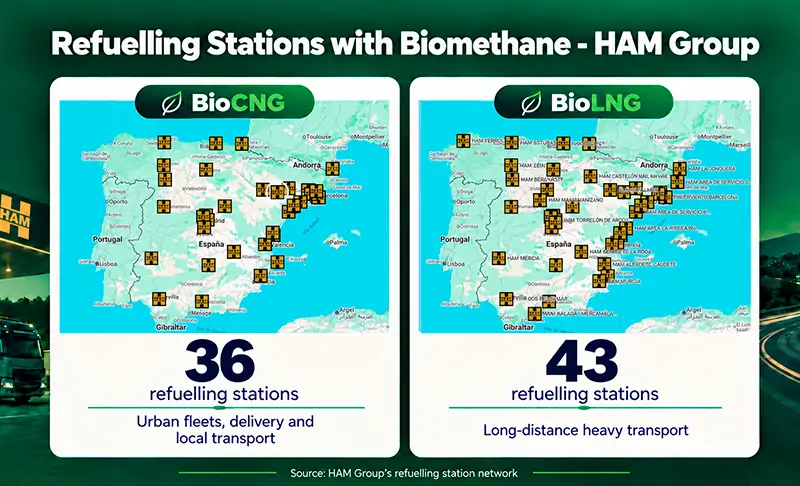
43 BioLNG stations and 36 BioCNG stations serving the transport industry
The introduction of biomethane throughout HAM Group's Spanish network enables the company to offer two refuelling options, tailored to the needs of different transport segments:
- 43 refuelling stations offering BioLNG (liquefied biomethane): primarily designed for long-distance heavy-duty transport, providing a renewable alternative for logistics companies and hauliers operating LNG-powered vehicles.
- 36 refuelling stations offering BioCNG (compressed biomethane): particularly suited to urban fleets, goods distribution, last-mile deliveries and local transport using CNG-powered vehicles.
Both options can be available at the same refuelling station, allowing different vehicle types and operational requirements to be accommodated.
The geographical distribution of these facilities across Spain facilitates access to biomethane along logistics corridors, in industrial areas and on strategic commercial transport routes, helping more companies incorporate renewable fuels into their daily operations.
One of the main advantages of BioLNG and BioCNG is their compatibility with vehicles currently running on LNG and CNG, respectively. This allows transport operators to reduce their greenhouse gas emissions without modifying their engines or replacing their vehicles, supporting a more accessible and operationally viable energy transition.
A commitment fulfilled, driving transport decarbonisation
The exclusive availability of biomethane at all gas refuelling points across our Spanish network represents a decisive step in HAM Group's strategy and reinforces our commitment to developing a more sustainable mobility model.
This milestone not only marks the fulfilment of a publicly announced objective but also demonstrates our determination to turn environmental commitments into tangible solutions, providing our customers with a fully operational renewable fuel refuelling network.
HAM Group's commitment to biomethane extends far beyond our refuelling stations. The company operates across different stages of the renewable gas value chain, providing solutions related to biomethane production, treatment, liquefaction, storage, transport and distribution.
This integrated approach connects the recovery of organic waste with its use as an energy resource in sectors such as transport and industry, contributing to the development of the circular economy and reducing dependence on fossil fuels.
HAM Group will continue driving biomethane development
The transformation of our entire refuelling station network marks a new starting point in our ongoing efforts to advance the energy transition.
At HAM Group, we will continue developing innovative solutions, improving our infrastructure and expanding access to renewable fuels, with the aim of supporting our customers in their decarbonisation strategies and providing efficient, competitive energy alternatives tailored to their operational needs.
With 36 BioCNG stations, 43 BioLNG stations and 100% of our Spanish network supplying biomethane, HAM Group has delivered on its commitment to promoting more sustainable mobility, demonstrating that transport decarbonisation is achievable with solutions available today.