
What is BioLNG?
BioLNG is biomethane from renewable sources in liquid form, obtained by liquefying gas at cryogenic temperatures (approx. -160 ºC) to reduce its volume and facilitate storage and transport.
In practice, we are talking about a fuel with the same applications as LNG in mobility, but with one key difference: its renewable origin, as it comes from the use of organic waste and by-products.
BioLNG = liquefied biomethane that can be transported and used efficiently in applications where high energy density is required (e.g. heavy transport).
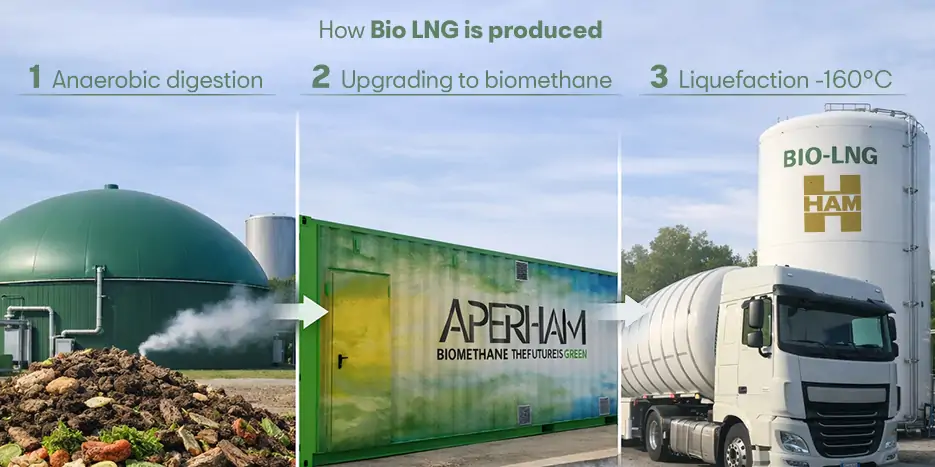
How BioLNG is produced step by step
From organic waste to biogas (anaerobic digestion)
Certain types of waste and by-products (agricultural, industrial, sludge, organic fraction, etc.) can be treated using anaerobic digestion to generate biogas.
Upgrading: from biogas to biomethane
The biogas is purified (upgraded) to remove CO₂, water and traces, and obtain a high-purity gas (biomethane), suitable for energy uses equivalent to natural gas.
Liquefaction: biomethane at -160 ºC
Biomethane is cooled to convert it into a cryogenic liquid, as is the case with LNG, but maintaining the renewable origin of the fuel.
What it is used for: heavy transport and other applications
Heavy transport (trucks and fleets)
BioLNG is used especially on long-distance routes, where the liquefied format offers greater autonomy and similar operation to LNG. In many cases, the practical difference compared to compressed options is precisely that: greater autonomy due to the higher energy density of liquefied fuel.
High energy demand environments
Due to its energy density and logistics, Bio LNG is also suitable for applications where liquid fuel facilitates large-scale supply and storage.

Traceability and sustainability: what to check
Renewable origin and guarantees of origin (overview)
In renewable gases, traceability matters: it is advisable to verify the origin and associated documentation (e.g. guarantees of origin frameworks and market rules that are being harmonised/updated in the EU).
Emissions measurement: why it depends on origin and chain
The actual impact (in CO₂ equivalent) depends on the type of waste, the process, logistics and how it is accounted for. Therefore, rather than promising a single figure, it is more serious to talk about methodologies, certification and traceability.
Where can you refuel with BioLNG?
Refuelling stations and regular routes
HAM Group operates a network of more than 150 refuelling stations with BioLNG and BioCNG, available 24/7/365 and offering standard payment options.
To plan routes, it is best to consult the list of BioLNG refuelling stations and check fuel availability at each location.
HAM card for professionals
If you operate a fleet, the HAM Card is designed for professional use (companies and self-employed professionals) and facilitates refuelling at stations.
Frequently asked questions about BioLNG
Are BioLNG and biomethane the same thing?
BioLNG is biomethane in liquid form. Biomethane is purified renewable gas; it can be used as gas (injection, industrial use, etc.) or converted to BioLNG to facilitate logistics and use in mobility.
Can I use BioLNG in an LNG truck?
BioLNG is designed to take advantage of the infrastructure and vehicles that operate with LNG, maintaining the focus on renewable fuel (always with the proper verification of specifications and refuelling/safety procedures).
How is it different from LNG?
They share the same physical state (cryogenic liquid) and basic storage/transport operations, with the key difference being the origin of the fuel: BioLNG comes from renewable biomethane.
How does it differ from BioCNG?
Mainly in the format: liquefied (BioLNG) versus compressed (BioCNG), which usually affects range and storage.
Contact the HAM Group
If you would like further technical information about BioLNG, supply for fleets or availability at stations, please contact our team and we will advise you according to your operations (routes, consumption, format and supply needs).